Short answer: does TitanFlow work?
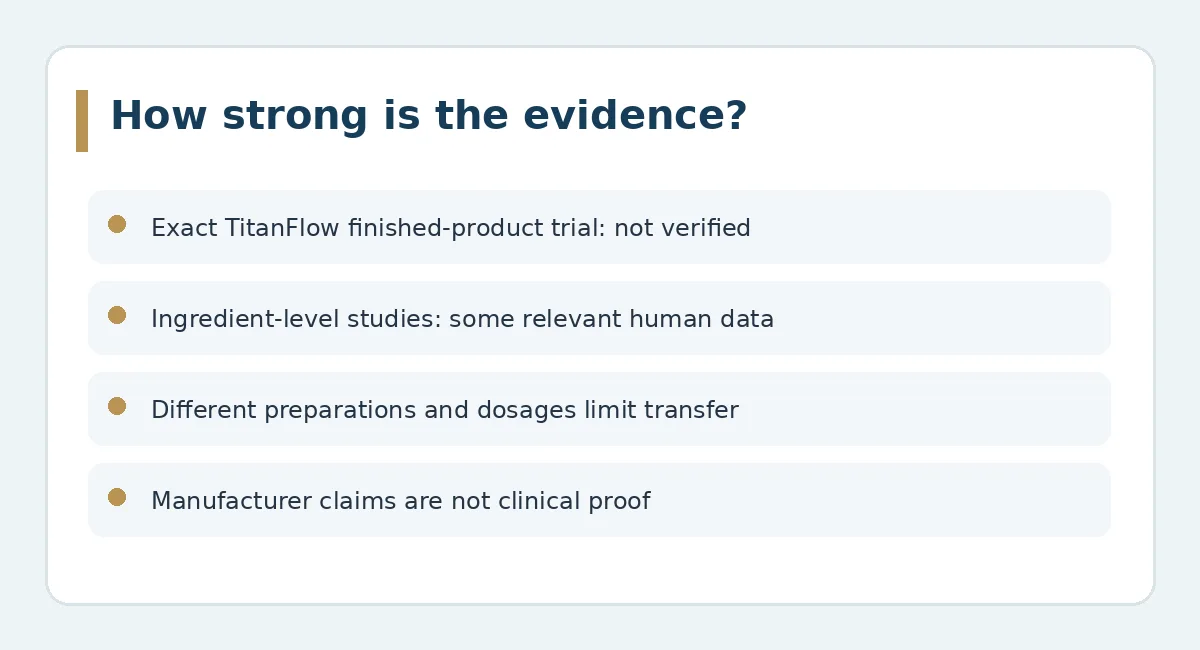
We cannot establish that TitanFlow's exact five-ingredient formula improves urinary flow, nighttime urination or other lower urinary tract symptoms. Some individual ingredients have been investigated in people with urinary symptoms, but research on separate preparations is indirect evidence for TitanFlow itself. We did not verify a published randomized controlled trial of the finished TitanFlow product in the sources searched for this draft. That is a search finding, not proof that no trial could exist. ⁽S3⁾⁽S4⁾⁽S11⁾
A responsible review therefore separates four levels of information: what the seller promises, what appears on a historical label, what independent human trials say about particular ingredients, and what is still unknown about the specific finished product.
What does Zenith Labs claim?
Zenith Labs markets TitanFlow for urinary support and publishes claims about fewer nighttime trips, stronger urinary flow and flushing toxins. Its product description goes further by describing pumpkin seed oil, glutathione, glyphosate clearance and a supposed restoration of urethral tissue. These statements describe the seller's theory and proposed effects; they have not been adopted as findings of this publication. ⁽S1⁾
Claim-to-evidence matrix
| Seller claim or theme | Best applicable evidence reviewed | Editorial conclusion |
|---|---|---|
| Better urinary flow | Research exists on certain beta-sitosterol and Pygeum preparations | Indirect, not product-specific proof |
| Less nighttime urination | Pygeum studies reported some short-term symptom changes | Indirect; no dependable TitanFlow outcome estimate |
| Glutathione increase | Biochemical mechanisms are not the same as a measured clinical endpoint | Not established for TitanFlow |
| Glyphosate clearance | No verified TitanFlow human outcome study demonstrating this claim | Unsubstantiated in evidence reviewed |
| Stronger/repaired urethral walls | No verified finished-product clinical evidence of this outcome | Unsubstantiated in evidence reviewed |
| Predictable results over a set period | No verified validated TitanFlow time-to-benefit trial | Do not promise a timeline |
What would count as convincing TitanFlow evidence?
An informative finished-product trial would use a defined TitanFlow formula, a credible comparator such as placebo, appropriate randomization and blinding, a relevant patient group, preregistered outcomes and adequate follow-up. Common urinary-symptom measures might include validated symptom scales, nighttime bathroom frequency, urine-flow rate and quality-of-life outcomes. Reporting harms and dropouts would matter as much as reporting potential benefits.
No source reviewed for this article provides sufficient verified trial results meeting those requirements for the exact marketed product. Manufacturer descriptions, testimonial videos and general statements that ingredients are “research-backed” do not fill the gap.
What do beta-sitosterol trials suggest?
A Cochrane systematic review published in 1999 pooled four randomized, double-blind, placebo-controlled studies involving 519 men. It found improved urinary symptom scores and some flow-related measurements for the beta-sitosterol preparations studied. The review also noted that longer-term safety, effectiveness and prevention of complications were not known, and different preparations were used across trials. It did not study TitanFlow. ⁽S3⁾
The TitanFlow historical label lists beta-sitosterol at 30 mg, while product-related materials refer to a “complex.” Without the active sterol content and formulation specification, we cannot map the complex directly to trial interventions. It would be misleading to write, “TitanFlow is clinically proven by four trials.”
What does Pygeum research suggest?
A Cochrane review published in 2002 found that certain Pygeum africanum extracts might improve short-term urinary symptoms and flow measures. However, the included studies were generally small and short, often involved different preparations and were not consistently reported with modern validated scales. NCCIH calls the relevant evidence limited. ⁽S4⁾⁽S11⁾
The historical TitanFlow label lists 100 mg of Pygeum bark extract, but this alone does not demonstrate that its extract matches the formulations from the trials. Further information about botanical standardization and current label identity is needed before drawing stronger conclusions.
What about pumpkin seed oil, broccoli sprout and lycopene?
Ingredient-level mechanistic interest is not proof of symptomatic benefit. Research involving pumpkin seeds or pumpkin oil must be checked for preparation, dose and participant comparability. The historical TitanFlow record provides no validated proof that the broccoli sprout extract achieves specific glucoraphanin or sulforaphane exposure or improves urinary outcomes. NCCIH specifically describes evidence for lycopene in BPH prevention and treatment as insufficient. ⁽S2⁾⁽S11⁾
The independent evaluation should therefore avoid assigning each ingredient a fabricated percentage contribution to TitanFlow's effectiveness. Where the best research does not match the exact preparation, the correct answer is uncertainty.
Does TitanFlow eliminate glyphosate or restore urethral tissue?
The manufacturer discusses a proposed sequence beginning with pumpkin seed oil, leading to glutathione production and glyphosate removal, followed by recovery of urethral tissue and stronger urinary flow. To establish that chain, evidence would need to show the described biochemical changes in people using TitanFlow and demonstrate that they meaningfully improve the relevant symptoms. The material reviewed for this draft does not establish those clinical steps. Accordingly, this theory should be reported strictly as a seller claim, not as established physiology or treatment efficacy. ⁽S1⁾
Is TitanFlow FDA approved or clinically certified?
The FDA does not approve dietary supplements for safety and effectiveness prior to marketing, unlike new drugs. Registration, inspection, good-manufacturing-practice language and inclusion in NIH label records should not be described as FDA endorsement of a particular supplement. A manufacturer bears responsibility for substantiating lawful product statements. ⁽S9⁾⁽S7⁾
Claims such as “doctor formulated” identify marketing positioning and do not demonstrate independent clinical review of this article or randomized testing of the product.
How long would it take to see results?
An evidence-based TitanFlow time-to-effect estimate cannot be stated without suitable product-specific clinical data. Trial durations in older beta-sitosterol or Pygeum research cannot automatically be converted into a promise that a TitanFlow user will see benefits after a particular number of days. Symptoms may fluctuate naturally, and other conditions or treatments may influence how someone feels. ⁽S3⁾⁽S4⁾
Do not postpone medical evaluation for persistent, worsening or concerning symptoms to complete an arbitrary supplement “trial period.” For guidance about risks, read TitanFlow Side Effects.
What are reasonable alternatives to a supplement-only decision?
The first step is understanding why symptoms are occurring. BPH is one possible cause of lower urinary tract symptoms, but not the only one. Depending on diagnosis and severity, clinical options can include watchful waiting, lifestyle changes, medicines and procedures. NCCIH advises discussing complementary approaches with healthcare professionals. ⁽S11⁾⁽S5⁾
This page does not recommend a particular medication or diagnose BPH. It explains why a supplement advertisement should not replace medical evaluation or established treatment decisions.
Bottom line
We did not verify finished-product clinical proof for TitanFlow. There is some human evidence concerning separate beta-sitosterol and Pygeum preparations, but it is uncertain whether those findings apply to this combination at its current doses and extract specifications. The strongest consumer decision is one made with accurate label information, an understanding of these limitations, appropriate medical advice and verified checkout terms.
FAQs
Is TitanFlow proven to improve urine flow? The evidence reviewed does not establish that outcome for the exact finished TitanFlow formula.
Do beta-sitosterol trials prove TitanFlow works? No. They studied particular preparations and cannot automatically be generalized to TitanFlow. ⁽S3⁾
Does TitanFlow cure enlarged prostate? There is no verified basis to claim it treats or cures BPH. Supplements should not be marketed as cures for disease. ⁽S9⁾
Can TitanFlow replace prescription prostate medication? No evidence reviewed supports substituting TitanFlow for prescribed treatment. Speak with the prescribing clinician.
Where are the exact ingredient amounts? See the TitanFlow Ingredients analysis.
Research/publication holds: RCT search should be rerun at launch; current formula and active-ingredient standardization need verification; no guaranteed efficacy or timeline may be asserted. Source register: 06-source-register-and-holds.md.
Research references
- S1 — https://zenithlabs.com/product/titanflow/
- S2 — https://hellopharmacist.com/drug-supplement-interactions/supplements/titanflow-by-zenith-labs-2553956
- S3 — https://www.cochrane.org/evidence/CD001043_herbal-medicines-containing-beta-sitosterols-may-help-relieve-urinary-symptoms-and-urinary-flow
- S4 — https://www.cochrane.org/evidence/CD001044_extracts-african-prune-tree-pygeum-africanum-may-be-able-help-relieve-urinary-symptoms-caused
- S5 — https://www.niddk.nih.gov/health-information/urologic-diseases/urinary-retention
- S7 — https://ods.od.nih.gov/Research/Dietary_Supplement_Label_Database.aspx
- S9 — https://www.fda.gov/food/information-consumers-using-dietary-supplements/questions-and-answers-dietary-supplements
- S11 — https://www.nccih.nih.gov/health/providers/digest/benign-prostatic-hyperplasia-and-complementary-and-integrative-approaches
Seller sources describe seller claims and policies, not independent evidence of health benefits.