What is in TitanFlow?
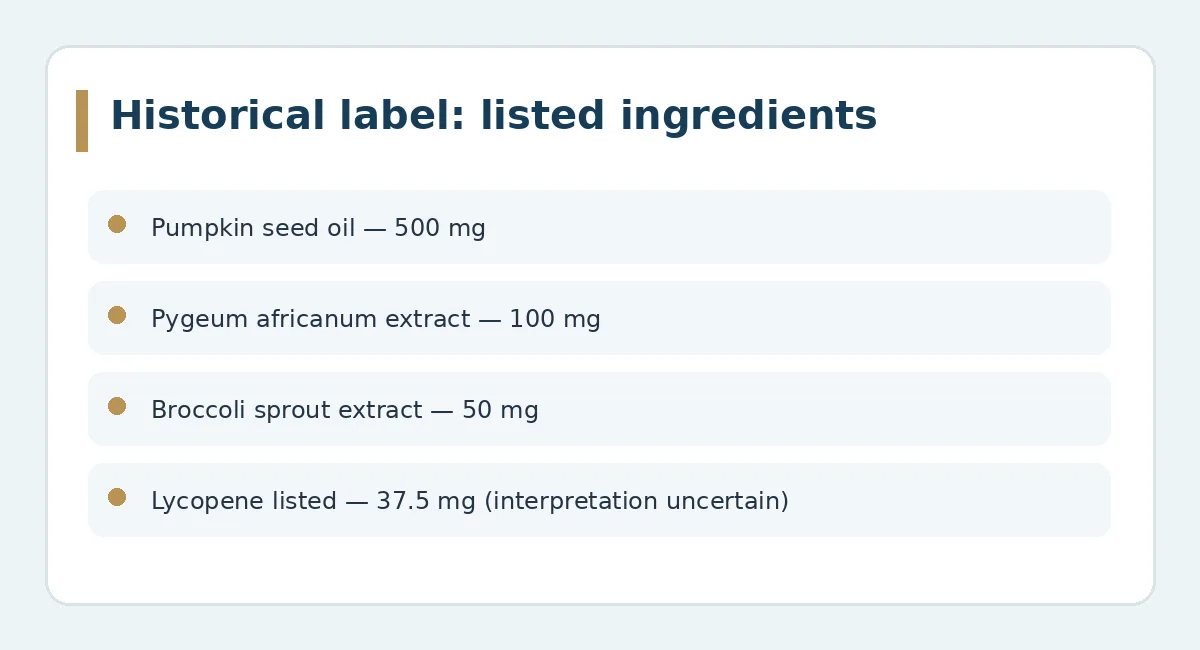
The March 2025 NIH-label-derived TitanFlow record lists five dietary ingredients in a two-capsule serving: 500 mg pumpkin seed oil, 100 mg Pygeum africanum bark extract, 50 mg broccoli sprout extract, 37.5 mg lycopene and 30 mg beta-sitosterol. These are recorded label quantities, not measurements independently confirmed by our laboratory. The record identifies 60 capsules and 30 servings per container. NIH's Dietary Supplement Label Database includes past and current marketplace labels, so the exact formula on sale in October 2026 still needs direct package confirmation. ⁽S2⁾⁽S7⁾
| Ingredient | Amount per recorded serving | Main evaluation question |
|---|---|---|
| Pumpkin seed oil | 500 mg | Is the oil chemically comparable to studied preparations? |
| Pygeum africanum | 100 mg | Which extract and standardization? |
| Broccoli sprout extract | 50 mg | How much of its proposed active compounds is present? |
| Lycopene | 37.5 mg | Is this a preparation or pure active lycopene? |
| Beta-sitosterol | 30 mg | How much actual beta-sitosterol is in the listed complex? |
A separately published product-oriented release describes the lycopene as a 5% preparation, broccoli and Pygeum as 4:1 extracts and beta-sitosterol as a complex. That description helps identify questions to ask but does not independently authenticate the current formulation. If 37.5 mg refers to a preparation containing 5% lycopene by mass, the arithmetic amount of pure lycopene would be 1.875 mg. This calculation is conditional, not a confirmed laboratory result. ⁽S10⁾
Pumpkin seed oil — 500 mg
Pumpkin seed oil appears in research concerning urinary symptoms and other aspects of health. However, results from one oil preparation cannot simply be transferred to another because fatty-acid composition, processing, dose, duration and participant selection may differ. Zenith Labs associates pumpkin seed oil with a glutathione and glyphosate narrative. In the sources reviewed for this article, a clinically validated connection from this exact TitanFlow dose to improved human urinary symptoms through that mechanism has not been established. ⁽S1⁾
What to verify: a current label, oil extraction method, fatty-acid assay, independent certificate of analysis (if made available) and any human trial of the exact or demonstrably comparable preparation. A 500 mg number by itself does not settle these questions.
Pygeum africanum bark extract — 100 mg
Pygeum is a botanical ingredient with a clinical research history in lower urinary tract symptoms associated with benign prostatic hyperplasia. A Cochrane review found possible short-term benefits in certain studies but emphasized weaknesses: many trials were small or short, and preparations and dosages varied. The U.S. National Center for Complementary and Integrative Health likewise characterizes the evidence as limited. ⁽S4⁾⁽S11⁾
The TitanFlow record lists a mass of extract, not the full chemical profile. Extract ratios such as “4:1,” when presented in promotional materials, do not establish the same active constituents or bioavailability as the materials studied in clinical trials. We therefore cannot infer expected symptom improvement from the 100 mg figure alone.
Beta-sitosterol — 30 mg
Beta-sitosterols are plant sterols studied for urinary symptoms. A 1999 Cochrane synthesis of four randomized controlled trials involving 519 men found improvements in some urinary symptom scores and flow measures, but could not establish long-term effectiveness, safety or prevention of BPH complications. Some preparations in those trials differed chemically from one another. ⁽S3⁾
TitanFlow promotional material refers to a beta-sitosterol complex. A 30 mg complex is not necessarily 30 mg of isolated active beta-sitosterol. Without a verified specification indicating actual active sterol content and formulation, a numerical one-to-one comparison with trial doses is not justified.
Lycopene — 37.5 mg listed
Lycopene is a carotenoid associated with tomatoes and other foods. NCCIH concludes that evidence is insufficient to support lycopene for prevention or treatment of benign prostatic hyperplasia. A biologically interesting antioxidant does not become an established BPH treatment merely by being present in a supplement. ⁽S11⁾
The quantity on the historical label should be read alongside the specific ingredient-form designation on the current package. Seller-linked materials refer to “Lycopene 5%,” which may indicate a standardized mixture. If so, the actual lycopene mass could be much lower than the mass of the mixture; the precise interpretation remains open until the current Supplement Facts and ingredient specification are reviewed. ⁽S2⁾⁽S10⁾
Broccoli sprout extract — 50 mg
Broccoli sprout preparations are often discussed for glucoraphanin, sulforaphane and their biological pathways. The record reviewed here does not establish the 50 mg ingredient's glucoraphanin or sulforaphane yield. Nor does the presence of a botanical extract demonstrate that a whole supplement will repair urethral tissue or remove glyphosate from the human body. Claims about those outcomes require appropriate human testing of the relevant preparation and final product. ⁽S1⁾⁽S2⁾
Other ingredients and capsule type
The historical label lists rice flour, silicon dioxide, magnesium stearate and gelatin. Gelatin means the recorded version is not vegetarian or vegan. Anyone with ingredient sensitivities, dietary constraints or medication-related concerns should check the current physical label rather than assume an older online panel is definitive. ⁽S2⁾
Dose comparison: why a milligram number is not enough
| Question | Why it matters | Present status |
|---|---|---|
| Same botanical species? | Different species may have different chemistry | Named, but full identity not independently tested |
| Same extract and standardization? | A 100 mg extract may differ from another 100 mg extract | Unverified |
| Same active-compound quantity? | Complexes and preparations may dilute active amounts | Unverified for key ingredients |
| Same route and formulation? | Capsules, oils and other deliveries are not always comparable | Exact study matching incomplete |
| Same outcome and patient group? | Research on biochemical markers does not equal symptom relief | Requires claim-specific appraisal |
| Finished-product human trial? | Most direct test of the combined formula | Not verified in research search |
For readers interested in clinical outcomes, see Does TitanFlow Work?. For safety, see Side Effects and Interactions.
How should TitanFlow be taken?
The historical label states: two capsules once daily, and advises against exceeding the recommended dose. The associated promotional sales page also says two capsules daily, ideally with the first meal. These are seller/label instructions, not medical advice from this publication. Confirm the current bottle and discuss supplement use with a healthcare professional, particularly if taking medication or managing urinary symptoms. ⁽S2⁾⁽S12⁾
A 60-capsule bottle would last 30 days if the current recommended serving remains two capsules daily. Do not infer that taking more leads to faster effects.
What can and cannot be concluded from this formula?
The useful fact is that the historical label discloses five amounts. The important uncertainty is whether those exact preparations correspond to clinical studies—and whether the full combination has been tested. Evidence for a plant sterol or Pygeum preparation cannot, by itself, establish TitanFlow's marketed effects. There is no good basis to promise a particular improvement in urinary frequency, stream strength or symptom timeline from these listed quantities alone.
FAQs
Does TitanFlow contain saw palmetto? Saw palmetto does not appear among the five active ingredients in the historical label reviewed here. Check the current bottle for any formulation update. ⁽S2⁾
Is TitanFlow vegan? The recorded formula lists gelatin, so that version is not vegan or vegetarian. ⁽S2⁾
Is 37.5 mg of lycopene necessarily pure lycopene? No. A standardized preparation percentage must be interpreted before calculating active lycopene.
Are the ingredient amounts clinically effective? The exact formula, extract standardizations and product-specific effects have not been established from the available evidence.
Can this article replace a pharmacist's interaction check? No. Review the current label and medications with a qualified professional.
Research references
- S1 — https://zenithlabs.com/product/titanflow/
- S2 — https://hellopharmacist.com/drug-supplement-interactions/supplements/titanflow-by-zenith-labs-2553956
- S3 — https://www.cochrane.org/evidence/CD001043_herbal-medicines-containing-beta-sitosterols-may-help-relieve-urinary-symptoms-and-urinary-flow
- S4 — https://www.cochrane.org/evidence/CD001044_extracts-african-prune-tree-pygeum-africanum-may-be-able-help-relieve-urinary-symptoms-caused
- S7 — https://ods.od.nih.gov/Research/Dietary_Supplement_Label_Database.aspx
- S10 — https://www.globenewswire.com/news-release/2026/04/08/3270489/0/en/titanflow-claims-evaluated-zenith-labs-prostate-support-formula-for-healthy-urinary-flow.html
- S11 — https://www.nccih.nih.gov/health/providers/digest/benign-prostatic-hyperplasia-and-complementary-and-integrative-approaches
- S12 — https://prostaterevealed.com/
Seller sources describe seller claims and policies, not independent evidence of health benefits.