Is TitanFlow safe?
There is insufficient verified finished-product evidence to state that TitanFlow is safe for everyone or free from side effects. The historical label identifies five ingredients and includes warnings about dosage, medications and existing medical conditions. Different users may have different risks, especially when other medicines are involved. Safety claims must be evaluated separately from seller statements that a supplement is “natural” or “doctor formulated.” ⁽S2⁾⁽S9⁾
This page is general educational information, not a diagnosis or a personalized medication-interaction check.
What warnings appear on the historical label?
The label-derived record instructs consumers not to exceed the recommended dose, to consult a physician before use especially when taking medication or managing a medical condition, to keep the product away from children, and not to use the product if the safety seal is damaged or missing. It indicates that the historical version is not for people younger than 18 or pregnant or nursing individuals. ⁽S2⁾
These are reproduced manufacturer-label statements. The current October 2026 physical packaging has not yet been independently inspected, so readers should review the actual product label before use. The associated seller funnel says two capsules per day, while the historical label specifies two capsules once daily. Do not alter the regimen on the basis of this website. ⁽S2⁾⁽S12⁾
What side effects could occur?
Any dietary supplement can produce unwanted effects or interact with medication. Possible tolerability concerns depend on the individual constituent, preparation, dose and health context. The research reviewed does not support a reliable frequency table for TitanFlow-specific nausea, abdominal symptoms, headache, allergic responses or other adverse events. Listing precise percentages would be fabricated.
The older Cochrane reviews discussing certain beta-sitosterol and Pygeum preparations described generally tolerable short-term trial experiences, but those findings do not establish the safety profile of this exact combined supplement, long-term use or use with multiple medicines. ⁽S3⁾⁽S4⁾
Ingredient-related uncertainties
| Historical ingredient | Safety information needed before an individualized decision |
|---|---|
| Pumpkin seed oil | Personal allergies, product quality, medication context |
| Pygeum extract | Specific extract, dosage, gastrointestinal tolerability and medication review |
| Beta-sitosterol complex | Active sterol amount, formulation, other concurrent treatments |
| Lycopene preparation | Actual active amount, other supplements and medication context |
| Broccoli sprout extract | Standardization, concentration and medication context |
This table identifies questions for a clinician or pharmacist rather than claiming a documented interaction occurs in every user.
Can TitanFlow interact with medications?
Interaction screening must consider the exact medicine name, dose, formulation, patient history and current supplement composition. A label or third-party ingredient-interaction flag cannot determine whether an individual can safely combine products. The historical TitanFlow label explicitly advises consulting a physician when taking medication. ⁽S2⁾
Readers using medication for urinary symptoms, cardiovascular conditions, clotting disorders or other chronic conditions should not independently stop, replace or adjust prescribed medicines to use TitanFlow. Bring the complete bottle label and medicine list to a healthcare professional or pharmacist. FDA encourages consumers to discuss supplements with healthcare professionals. ⁽S9⁾
Who should obtain medical advice before use?
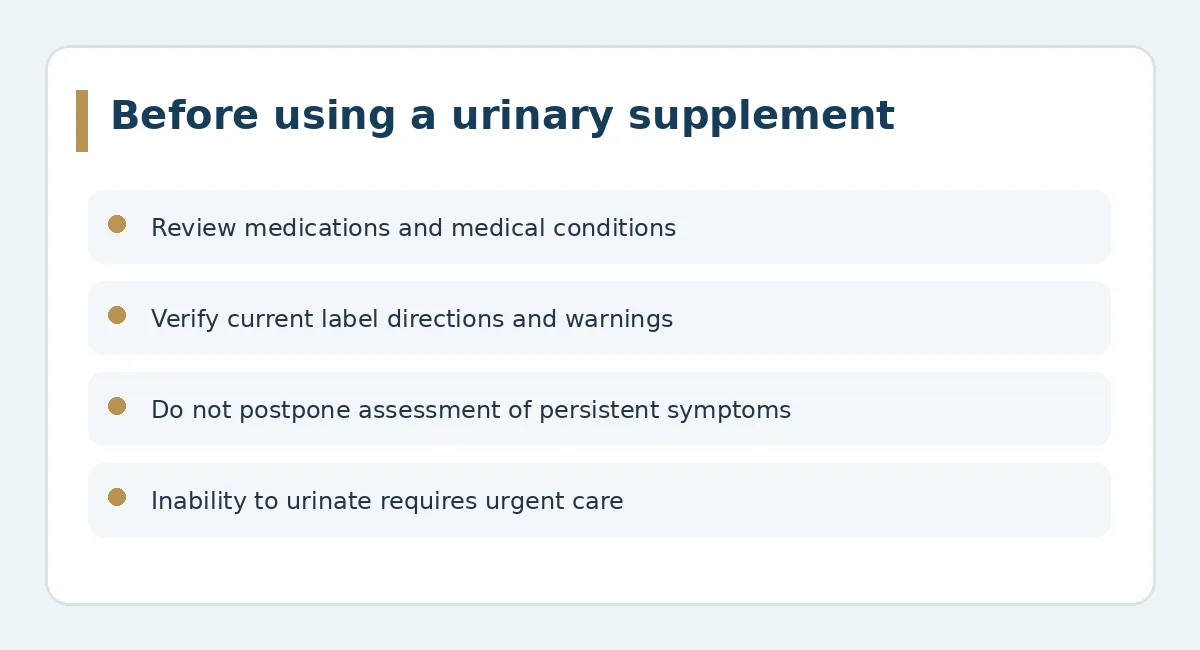
Particular caution is appropriate when a person is already under treatment for urinary symptoms, uses prescription medicines, has kidney or liver disease, has had urinary retention, experiences blood in urine, or is considering multiple simultaneous supplements. These examples are prompts for medical assessment rather than a list of proven TitanFlow contraindications. The manufacturer warns people with medical conditions to consult a physician. ⁽S2⁾
The historical capsule contains gelatin. People with allergies or dietary restrictions should verify every ingredient and any recent formula change. ⁽S2⁾
Which urinary symptoms should not be managed with a supplement alone?
Problems urinating may arise from BPH, infection, obstruction, medication effects and other conditions. Inability to pass urine requires urgent medical assessment; new blood in the urine, fever with urinary symptoms, severe pain or rapidly worsening symptoms also need prompt care. Persistent frequency, weak stream or nighttime urination deserve appropriate evaluation rather than assuming the cause is harmless prostate enlargement. ⁽S5⁾
A supplement should not be used to delay necessary tests, medical treatment or follow-up.
Can “natural” and “FDA inspected” mean no risk?
No. Being plant-derived does not automatically make a substance safe for a particular person. FDA oversight of supplements is different from premarket approval of drugs; FDA does not approve dietary supplements for safety and efficacy before marketing. Claims about facility inspection or manufacturing systems must not be converted into claims that the product itself is FDA approved. ⁽S9⁾
Likewise, the presence of a historical NIH label record does not mean NIH has tested or endorsed the bottle. The DSLD is a database of reported labels, including historical records. ⁽S7⁾
How can a consumer assess an unwanted reaction?
Seek advice from a clinician or pharmacist if symptoms arise or worsen after starting any supplement. For severe reactions or medical emergencies, seek urgent care. Save the container, ingredient panel, batch information and timing of use for a professional evaluation. Adverse events involving dietary supplements can be reported to the FDA through its safety reporting channels. ⁽S9⁾
Evidence limitations
We have not independently tested TitanFlow for purity, contaminants, actual ingredient content or adverse-event frequency. We have not reviewed a published trial adequately measuring adverse effects of this exact finished product. The safety profile cannot be inferred from short-term trials of different individual preparations.
Bottom line
TitanFlow's available historical labeling provides important warnings, but does not demonstrate safety for all users. Its marketed urinary-support role does not replace finding the cause of symptoms. Confirm the current formula and ask an appropriate health professional to assess interactions with any existing medical regimen.
Related reading: TitanFlow ingredient details · Effectiveness and research limits · Complete review.
FAQs
Does TitanFlow have zero side effects? No credible basis supports that absolute claim.
Can I take TitanFlow with a prescribed prostate medicine? Only a qualified healthcare professional familiar with your medications and health history can assess that combination.
Should I stop prescribed medicine if TitanFlow seems helpful? Do not stop or modify prescribed treatment without your clinician's guidance.
Is the formula vegetarian? The historical label contains gelatin, so that formulation is not vegetarian. Verify the current package. ⁽S2⁾
Does FDA approval guarantee it is safe? TitanFlow should not be represented as FDA-approved for safety or effectiveness; FDA does not preapprove dietary supplements in that manner. ⁽S9⁾
Research references
- S2 — https://hellopharmacist.com/drug-supplement-interactions/supplements/titanflow-by-zenith-labs-2553956
- S3 — https://www.cochrane.org/evidence/CD001043_herbal-medicines-containing-beta-sitosterols-may-help-relieve-urinary-symptoms-and-urinary-flow
- S4 — https://www.cochrane.org/evidence/CD001044_extracts-african-prune-tree-pygeum-africanum-may-be-able-help-relieve-urinary-symptoms-caused
- S5 — https://www.niddk.nih.gov/health-information/urologic-diseases/urinary-retention
- S7 — https://ods.od.nih.gov/Research/Dietary_Supplement_Label_Database.aspx
- S9 — https://www.fda.gov/food/information-consumers-using-dietary-supplements/questions-and-answers-dietary-supplements
- S12 — https://prostaterevealed.com/
Seller sources describe seller claims and policies, not independent evidence of health benefits.